If you have been putting off a tree removal because you are afraid of the bill, you are not alone. It is the first question almost every homeowner asks us, and the honest answer is that price depends on the tree, the yard, and the risk involved. Below is a plain-English breakdown of what tree removal costs in Lake County, Illinois, what changes the price, and how to tell a fair quote from a bad one.
Quick answer: Expect roughly $300 to $1,500 for a small to medium tree, and $1,500 to $3,000+ for a large or hazardous one. These are typical industry ranges to help you budget, not a quote. The only accurate number comes from someone looking at your tree.
Typical Tree Removal Prices by Tree Size
Height is the biggest single factor because a taller tree means more rigging, more time, and more wood to cut, lower, and haul. Here is a general guide for a standard residential job with reasonable access:
| Tree size | Typical height | Typical price range |
|---|---|---|
| Small | Under 30 ft | $200 – $600 |
| Medium | 30 – 60 ft | $600 – $1,500 |
| Large | 60 – 80 ft | $1,500 – $3,000 |
| Very large or high-risk | 80 ft and up | $3,000 and up |
Lake County has plenty of tall, mature trees, including silver maples, cottonwoods, box elders, and old oaks. Many of them are in the medium-to-large range, which is why a straight-up “how much per tree” number rarely holds up once someone sees the actual yard.
What Makes Tree Removal Cost More (or Less)
Access to the tree
A tree in an open front yard where a truck can pull up is far cheaper than one behind a house, over a fence, or in a tight backyard. When equipment cannot reach it, crews have to climb and carry everything out by hand, and that takes real time.
Distance to your house, fence, and power lines
Trees close to a roof, a sunroom, a pool, or utility lines cannot simply be dropped. Sections are roped down piece by piece, which is slower and needs more people and skill. This is the part of the job where professional tree removal earns its price, and where insurance and experience matter most.
Condition of the tree
Dead, rotting, or storm-split trees are more dangerous to climb and cut, so they can cost more than a healthy tree of the same size. A dead ash tree, for example, becomes brittle, and limbs can fail without warning. Lake County has lost a great many ash trees to the emerald ash borer, and those are some of the most common removals we see.
Cleanup and haul-away
Ask exactly what is included. Some quotes cover full debris haul-away and chipping, while others leave the logs and brush for you. Our quotes are written so you know up front what leaves your yard and what stays, like firewood-length rounds if you want them.
Stump removal
Cutting a tree down leaves the stump behind. Stump grinding is typically priced by stump diameter, with a minimum charge, and is usually a separate line item. If you know you want the stump gone, get both prices in one estimate.
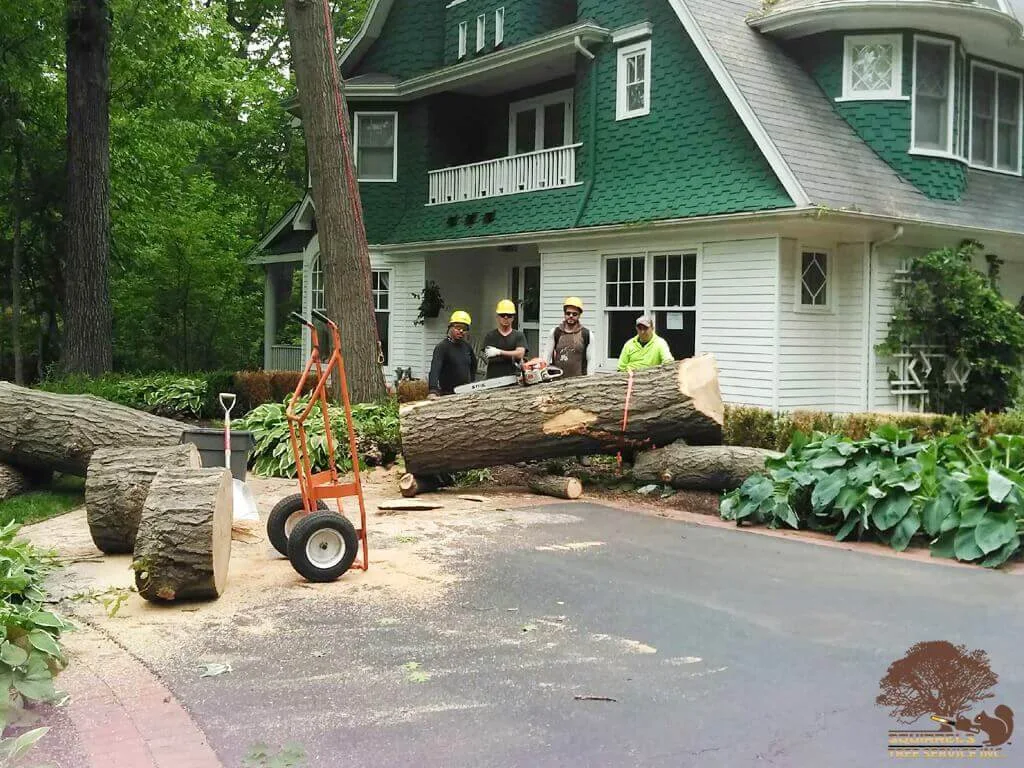
Emergency and storm work
If a tree is already on your roof or across the driveway after a storm, the job is riskier and often happens outside normal hours, so it usually costs more than a planned removal. We cover this in more detail on our emergency and storm cleanup page. If damage is involved, take photos before anything is moved. It makes an insurance claim much smoother.
Does Insurance Cover Tree Removal?
It depends on why the tree is coming down. In general, homeowners insurance may help when a tree falls onto a covered structure like your house, garage, or fence, and it often does not cover removing a healthy tree or one that died of age or disease. Policies vary, so check with your agent. Either way, a clear written estimate from a licensed and insured company makes the claims process easier.
Do You Need a Permit to Remove a Tree in Lake County?
Rules are set at the village or city level, not by the county. Some municipalities regulate the removal of larger or protected trees, particularly on lots under development or in older, tree-lined neighborhoods. Before scheduling, it is worth a quick call to your village hall. If you are not sure who to call, ask us and we will help you sort it out.
How to Spot a Fair Tree Removal Quote
- It is in writing and spells out what is included: removal, cleanup, wood, and stump.
- The company is licensed and insured. Ask for proof. An uninsured crew can leave you liable for an injury or damage on your property.
- Someone actually looked at the tree. A number given sight unseen is a guess.
- No pressure tactics. Be cautious of “today only” pricing or large cash deposits up front.
- The plan makes sense. A good crew can explain how the tree will come down and how your lawn, fence, and roof will be protected.
The cheapest bid is not always the best one. A low price from a crew without insurance or the right equipment can cost far more if something goes wrong.
Ways to Keep Tree Removal Costs Down
- Bundle the work. Removal, stump grinding, and brush chipping in one visit is usually more efficient than three separate calls.
- Clear the work area. Moving vehicles, patio furniture, and play equipment out of the way saves crew time.
- Act before the tree gets worse. A declining tree is cheaper to take down before it drops limbs or damages something.
- Skip the emergency premium when you can. If a tree is leaning, cracked, or dead, do not wait for the next storm to force the issue.
Not sure the tree needs to come down at all? Sometimes tree trimming or pruning solves the problem for less. We will tell you honestly which one you need, even if that means the smaller job.
We serve Zion and the surrounding Lake County area, including Waukegan, Gurnee, Winthrop Harbor, Antioch, and Lake Villa. You can also read more about our tree service in Zion and Lake County, or see our recent work.
Frequently Asked Questions
How much does it cost to remove a tree in Lake County, IL?
Most residential tree removals fall between roughly $300 and $1,500 for small to medium trees, and $1,500 to $3,000 or more for large, hazardous, or hard-to-reach trees. Access, height, condition, and nearby structures move the price more than anything else.
Is stump grinding included in the tree removal price?
Usually not. Stump grinding is normally quoted separately. If you want the stump gone, ask for both prices on the same estimate. Doing both in one visit is often cheaper than booking them separately.
Does homeowners insurance pay for tree removal?
Often it does when a storm drops a tree onto your house, garage, fence, or driveway and damages the structure. Insurance generally does not cover removing a healthy tree or one that simply died of age or disease. Check your policy or ask your agent before the work starts, and keep photos.
Do I need a permit to remove a tree in Lake County?
It depends on the village or city. Some Lake County municipalities have tree ordinances that cover larger or protected trees, especially on lots that are being developed. A quick call to your village hall before removal answers it, and we are happy to point you in the right direction.
Why is emergency tree removal more expensive?
After a storm, crews are called in after hours and often work around damaged roofs, power lines, and unstable wood. That takes more people, more equipment, and more risk, so emergency work is usually priced higher than a scheduled removal.
Is it cheaper to remove a tree in winter?
Sometimes. Tree work is slower in the colder months, so scheduling can be easier and occasionally cheaper. Frozen ground can also protect your lawn from equipment. Dead or dangerous trees should not wait for a better season.
Get a Free, Honest Estimate
Every tree and yard is different, so the only real price is one based on a look at your property. Call or send a few photos and we will give you a clear, written quote with no surprises.